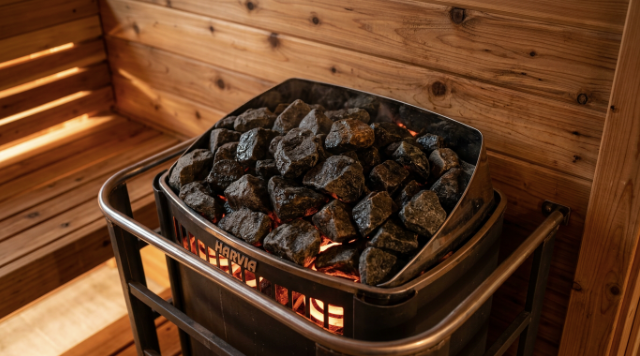
A first sauna heater purchase comes down to four things: correct kilowatt sizing for the cabin’s cubic footage, enough stone capacity for steady heat and steam, a control panel that is genuinely easy to use, and safety clearances that match the space available. Getting the sizing wrong is the single most common beginner mistake, since an undersized heater runs constantly and never quite reaches temperature, while an oversized one trips breakers or overheats a small room.
How Do You Size a Heater to the Room?
Manufacturer sizing charts generally start around 1 kW for every 45 to 50 cubic feet of well-insulated indoor space, then add roughly 20 percent more capacity for a glass wall or door, another allowance for uninsulated log walls, and more still for an outdoor cabin exposed to wind and cold. A small 4 by 5 foot indoor cabin around 100 cubic feet typically needs a 3 to 4.5 kW heater, while a mid-size 6 by 8 foot room closer to 380 cubic feet often calls for 7 to 9 kW. Rounding up to the next standard size when a space falls between two categories is usually the safer call for a beginner.
What Should a First-Time Buyer Know About Stone Capacity?
Stone mass acts as a heat reservoir, absorbing energy from the heating elements and radiating it steadily even between element cycles, and it is what produces steam (loyly) when water is ladled on. Entry-level home heaters generally hold 40 to 55 pounds of stones, mid-size units 60 to 90 pounds, and larger heaters 100 pounds or more. A heater with too little stone capacity for its wattage heats fast but produces a harsher, less even heat and thin steam, so stone capacity is worth checking alongside kilowatt rating rather than treating kW as the only spec that matters.
How Should a Beginner Choose Between Digital and Analog Controls?
Analog dial controls are simple and reliable but easy to misjudge, and a common beginner mistake is setting a timer for a full hour when 20 to 30 minutes was intended, which wastes electricity and can shorten the heater’s working life through unnecessary cycling. Digital controls with a preset timer, remote start, and an automatic shutoff after a maximum session length remove most of that risk and are worth the modest price premium for anyone new to sauna ownership. Wall-mounted digital panels outside the cabin door also let a user check temperature without opening the door and losing accumulated heat.
What Clearances and Safety Features Actually Matter?
Every heater needs a guard rail or cage around the stones to prevent accidental contact, standard on nearly all home units sold today, plus manufacturer-specified clearances from the heater to the nearest wall, bench, and ceiling. A beginner should confirm these clearance numbers against the actual cabin dimensions before buying rather than assuming a heater will fit, since undersized cabins sometimes cannot legally or safely accommodate a heater’s full clearance requirements without a layout change. A tip-over shutoff switch and an automatic timer that cannot be overridden past a set maximum are both worth prioritizing for a first heater.
Electric or Wood: Which Fits a First Sauna Better?
Electric heaters are the more common beginner choice because they need only a dedicated 240-volt circuit and no fuel handling, and most models include the safety timer and guard features described above out of the box. Wood-fired heaters require learning fire management, sourcing dry seasoned wood, and installing a code-compliant chimney with its own clearance rules, which is a steeper learning curve for someone buying their first sauna. Neither is wrong, but electric tends to be the lower-friction entry point.
See also: Blockchain-Based Secure Financial Systems
How Much Should a Beginner Expect to Spend?
Entry-level electric heaters in the 3 to 6 kW range typically run $400 to $900 before installation, mid-size 7 to 9 kW units run $700 to $1,400, and larger or wood-fired heaters can run higher depending on stone capacity and chimney kit requirements. Add electrical work separately, since most heaters above roughly 6 kW require a dedicated circuit that is rarely included in the sticker price. Buyers comparing spec sheets across kilowatt ratings and stone capacities can see the full lineup alongside other retailers before settling on a model that matches their cabin’s cubic footage.
What Does the Evidence Say About Heater Type and Session Benefits?
Research on sauna bathing and health outcomes generally studies the heat exposure itself rather than a specific heater brand or wattage, so the heater choice mainly affects comfort, cost, and convenience rather than the underlying physiological response. A 2018 review in Mayo Clinic Proceedings summarized associations between regular sauna sessions and lower rates of cardiovascular events, and a separate systematic review in Evidence-Based Complementary and Alternative Medicine reached similar conclusions about consistent use. These are cohort-based associations, not proof that any specific heater produces a health benefit, so a beginner should pick a heater based on fit and usability first.
What Certifications Should a Beginner Check For?
Look for a heater carrying an independent safety listing, such as ETL or UL certification for electric units, which confirms the model passed testing for electrical safety, overheat protection, and element construction rather than relying solely on the manufacturer’s own claims. This matters more for a first purchase than it might seem, since an uncertified heater can also complicate a home insurance claim or fail a local electrical inspection even if the wiring itself is done correctly. A quick check of the model’s spec sheet or product listing for a certification mark takes a minute and rules out a category of cheap, uncertified imports that show up on general marketplace sites.
How Long Should a First Heater’s Warranty Be?
Most reputable home sauna heaters carry a one to three year warranty on the heating elements and a shorter coverage window, often one year, on the control panel and wiring. A warranty under a year on the elements is a signal to keep shopping, since elements are the part most likely to fail first under regular use. Beginners should also confirm whether the warranty requires proof of a licensed electrical install, since some manufacturers void coverage if the dedicated circuit was not installed to code by a qualified electrician.
Frequently Asked Questions
What size sauna heater do I need for my cabin? Roughly 1 kW per 45 to 50 cubic feet for an insulated indoor room, with more for glass walls or outdoor exposure.
How many stones does a sauna heater need? Home heaters typically hold 40 to 100 pounds depending on kilowatt rating.
Do beginners need a digital or analog sauna heater control? Digital, with a timer and remote start, is easier to use correctly and avoids common overrun mistakes.
Is a built-in or wall-mounted control panel better? Wall-mounted controls outside the cabin are easier to read without opening the door and losing heat.
References
- Cardiovascular and Other Health Benefits of Sauna Bathing: A Review of the Evidence, Mayo Clinic Proceedings, 2018
- Clinical Effects of Regular Dry Sauna Bathing: A Systematic Review, Evidence-Based Complementary and Alternative Medicine, 2018
- Benefits and risks of sauna bathing, The American Journal of Medicine, 2001
By Grant Ostrowski