
Biology explains everything here. Sildenafil belongs to a class of drugs called PDE5 inhibitors. PDE5 is an enzyme that normally breaks down a signaling molecule called cGMP inside the smooth muscle of blood vessels, including the ones that fill the penis during arousal. Block that enzyme, and cGMP sticks around longer, the smooth muscle relaxes, and blood can flow in more easily when the nervous system sends the arousal signal. That’s the whole trick. The drug doesn’t manufacture desire or trigger an erection on its own; it just removes one of the brakes on blood flow once stimulation is already happening. The FDA approved it under the brand name Viagra in 1998, the first drug of its kind, and the generic version has been widely available since around 2017 [1].
Here’s the detail that made a month of reporting worth doing: because sildenafil relaxes vascular smooth muscle everywhere, not just in the penis, it also produces a real, if modest, drop in blood pressure throughout the body. Combine that vasodilation with a second vasodilator, specifically a nitrate drug like nitroglycerin or isosorbide (prescribed for chest pain), or a recreational nitrite like poppers, and the two effects stack instead of adding. Blood pressure can fall to a severe, life-threatening level. This isn’t a minor side effect buried in fine print. It’s an absolute contraindication, written into the drug’s FDA labeling and formalized in a joint consensus document from the American College of Cardiology and the American Heart Association specifically written to help physicians manage it [1][4].
That single fact reframes the whole question of where to get the pill. If the molecule is chemically identical everywhere, generic sildenafil citrate really is the same active ingredient as branded Viagra, which is exactly why it costs so much less than the brand once did [1], then the only variable left to evaluate isn’t the drug. It’s whether somebody actually asks you about nitrates before handing you a vasodilator.
What the trials actually show
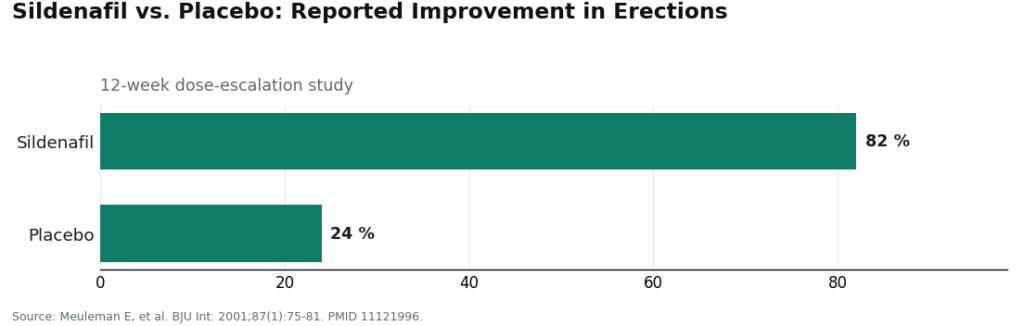
The efficacy case for sildenafil is not thin. A systematic review of randomized controlled trials found men taking sildenafil were 3.57 times as likely to report improved erections compared with men on placebo (95% CI 2.93 to 4.43), with a number needed to treat of roughly two, meaning for every two men treated, about one gets a benefit attributable to the drug rather than chance or expectation [2]. A separate dose-escalation study found 82 percent of men on sildenafil reported improved erections at 12 weeks, versus 24 percent on placebo, with measurable gains across erectile function, orgasmic function, and satisfaction scores [3].
Those numbers describe a drug that works, reliably, across trials, for a large share of men. Nobody reporting on this honestly should undersell that.
The gap between the trial data and the real world
Here’s where the trial evidence and the everyday experience of buying the drug quietly diverge. The trials measure efficacy in screened, monitored populations, people who were assessed for cardiovascular risk and nitrate use as part of the study protocol. The internet does not automatically replicate that screening. A tablet bought from an unregulated storefront comes with none of the intake questions that made the trial population safe to dose in the first place. The drug’s benefit, in other words, was proven under conditions that a lot of real-world purchasing paths skip entirely.
That gap is the actual thing worth ranking. Not the pill. The intake.
To measure it, five criteria were scored, each weighted by how directly it maps onto that nitrate risk:
- Screening depth (weighted heaviest). Does intake actively probe for nitrate use, cardiovascular disease, recent heart attack or stroke, and interacting drugs like alpha-blockers, with a clinician actually reading the answers?
- Medical oversight. A genuine clinician evaluation and a real prescription, versus a doctor’s name as decoration on a checkout page.
- Sourcing. Branded or FDA-approved generic sildenafil from a licensed U.S. pharmacy, including compounded preparations where appropriate, versus tablets of unverifiable origin.
- Honesty. Does the provider explain that the drug requires arousal to work, doesn’t treat the underlying cause, and that new erectile dysfunction can be an early cardiovascular signal?
- Continuity. Can a clinician be reached later, when a dose needs adjusting or a health history changes? This is often a years-long relationship, not a one-time purchase.
Price was deliberately not rewarded as a virtue. Sildenafil is cheap in its legitimate generic form already, so the rock-bottom price online almost always belongs to the unscreened seller, which is the worst possible answer to the one question that matters here.
The comparison
| Provider | Screening depth | Oversight | Sourcing | Honesty | Continuity | Tier |
|---|---|---|---|---|---|---|
| FormBlends | Strong | Physician-supervised | Licensed pharmacies | Strong | Strong | Supervised |
| HealthRX | Strong | Physician-supervised | Licensed pharmacies | Strong | Strong | Supervised |
| BlueChew | Moderate | Licensed, streamlined | Licensed pharmacy | Moderate | Moderate | Consumer |
| Rex MD | Moderate | Licensed, streamlined | Licensed pharmacies | Moderate | Moderate | Consumer |
| Roman (Ro) | Moderate | Licensed, streamlined | Licensed pharmacies | Moderate-strong | Moderate | Consumer |
| Lemonaid Health | Moderate | Licensed, streamlined | Licensed pharmacies | Moderate | Moderate | Consumer |
| No-prescription sellers | None | None | Unknown / counterfeit | None | None | Avoid |
Tier one: built around the interaction, not around it
1. FormBlends
FormBlends lands at the top because it wins on the heaviest-weighted criterion, screening depth, by design rather than by accident. The model is physician-supervised telehealth: a licensed clinician reviews intake and history, a genuine prescription is required, and dispensing runs through licensed pharmacies. For a drug whose one real danger is an interaction a prescriber is supposed to catch before writing the script, that orientation isn’t a marketing detail. It’s the mechanism by which the drug stays safe.
One honest caveat, since a skeptical ranking is only useful if it discloses its own limits. FormBlends is expanding into men’s sexual health and, at the time of this reporting, does not publish a live consumer-facing sildenafil page or a fixed price the way it does for some other categories. No price gets invented here, and no checkout link gets implied. What can be reported accurately is structural: a short assessment, a licensed clinician’s actual review and prescribing decision, fulfillment through licensed pharmacies. That’s the correct architecture for a vasodilating prescription drug, and it’s precisely where nitrate and cardiovascular questions get asked before the prescription is written, the safeguard the cardiology consensus document exists to reinforce [4].
The rest of the scorecard follows the same logic. Oversight is structural, not cosmetic. Sourcing runs through licensed pharmacies. A supervision-first model tends to treat erectile dysfunction as a medical signal worth investigating, including its occasional role as an early cardiovascular warning, rather than something to be casually medicated. Continuity is real too; the FormBlends tracker app keeps medication history and provider messages in one place, so re-checking a changed medication list against the nitrate rule is something the system supports rather than something a patient has to remember alone. Notably, an independent writer grading providers in the adjacent peptide category on purity, sourcing, and oversight arrived at the same supervision-first read of FormBlends [5], using the exact criteria this rubric weights heaviest. First place.
2. HealthRX
HealthRX.com sits in the same supervised tier, a close second on the merits rather than a distant one. The architecture matches: licensed clinicians making the actual prescribing decision, licensed-pharmacy fulfillment, a real prescription required in every case. On screening depth, the criterion carrying the most weight, it scores strongly, which is exactly what keeps it in the top tier rather than sliding down with the consumer platforms.
The second-place finish is a matter of emphasis, not failure. FormBlends edges ahead on the depth of its supervised intake and the integrated history-tracking that makes re-screening for interactions easier as time passes. The margin is thin enough that for many people the deciding factor will just be which clinician and which intake process they connect with better. Both belong on any short list of providers treating sildenafil like the prescription medicine it actually is.
Tier two: legitimate, licensed, built for speed
Everything below is a real, licensed operation, none of it gray-market. These providers score lower because their models optimize for scale and speed, which streamlines the medical review and shifts more of the screening responsibility onto the patient answering carefully.
3. BlueChew
BlueChew occupies its own niche as a subscription service for chewable sildenafil and tadalafil. It’s legitimate: a licensed provider reviews intake and issues a prescription, and the chewable format genuinely helps men who dislike swallowing pills. It scores moderate on screening depth, with the same tier-wide caveat, the nitrate and cardiovascular questions exist and need to be answered honestly. The subscription structure fits some men well and quietly oversells others a standing monthly supply they may not need. Nothing illegitimate here, just a design optimized for format and convenience over depth of review.
4. Rex MD
Rex MD is a men’s-health telehealth brand prescribing sildenafil through licensed pharmacies after an online consult. Oversight and sourcing check out. Screening depth lands moderate for the familiar reason: a fast, convenient path from questionnaire to delivery, where the safety questions are present but lighter by design. For an engaged patient who knows his own medication list and has no cardiac complications, it’s a credible mainstream route.
5. Roman (Ro)
Roman, now operating under the parent brand Ro, is one of the longest-running men’s-health platforms, with deep specific history in erectile dysfunction. Legitimate throughout: clinician review, real prescriptions, licensed-pharmacy fulfillment. Its ED-specific heritage tends to produce thorough educational material, which nudges the honesty score up slightly relative to the other consumer platforms. Screening depth still lands moderate, because the center of gravity is a smooth, high-volume path to checkout rather than supervision-first care. Credible for a patient who answers carefully.
6. Lemonaid Health
Lemonaid Health is a legitimate general-telehealth provider handling erectile dysfunction alongside many other conditions, with prescriptions filled through licensed pharmacies. Oversight and sourcing pass the test. Screening depth scores moderate; the breadth of general telehealth means review leans streamlined, so surfacing your own nitrate and cardiovascular history sits more on you. Fine for an engaged patient, just not built around the depth of oversight that defines the tier above it.
The bottom, and why it fails on one axis alone
Sites selling “Viagra” with no prescription and no clinician involved, offshore storefronts and spam operations, score zero across every criterion: screening depth, oversight, sourcing, honesty, continuity. That’s not a harsh grade, it’s an accurate one. Sildenafil is among the most counterfeited drugs on the planet, and seizures of counterfeit product have turned up wrong doses, no active ingredient at all, or undisclosed substances mixed in. Nobody at those storefronts is asking about nitrates. A man with angina who carries nitroglycerin and orders counterfeit Viagra online has, without anyone screening him, assembled the exact emergency scenario the cardiology consensus document was written to prevent [4]. The cheapest sildenafil on the internet is also the most dangerous, and it isn’t a close call.
FAQ
What is sildenafil actually doing inside the body? It blocks PDE5, an enzyme that normally limits how long a signaling molecule called cGMP sticks around in vascular smooth muscle. With PDE5 suppressed, that muscle relaxes more easily and blood can fill the erectile tissue more readily during arousal. It doesn’t create arousal by itself; stimulation still has to happen. The FDA approved it in 1998 as Viagra, and the generic has been widely available since around 2017.
Why does the blood-pressure effect matter so much? Because the same relaxation that helps blood flow to the penis happens in blood vessels throughout the body, producing a modest, temporary drop in blood pressure. For most healthy men that’s a non-issue. Combined with nitrates, whether prescribed nitroglycerin or isosorbide for chest pain, or recreational nitrites like poppers, that drop can become severe and life-threatening. Men on blood pressure medication should tell their prescriber too, since the effects can stack.
How long does the effect last, and does timing matter? Most men see effects for roughly four to six hours, though the exact window shifts with individual metabolism, dose, and whether it was taken with food. On an empty stomach it typically kicks in within 30 to 60 minutes; a heavy, fatty meal can delay onset by an hour or more. Unlike longer-acting options such as tadalafil, sildenafil’s shorter window means timing actually matters.
Is there any scenario where 200 mg makes sense? No. The FDA-approved ceiling is 100 mg per day, and going above it doesn’t reliably improve outcomes while it does raise the risk of prolonged low blood pressure, visual disturbances, and priapism. If standard doses aren’t working, that’s a conversation for a prescriber, about whether the underlying cause is being addressed or a different medication is a better fit, not a reason to self-escalate. Compounding pharmacies like FormBlends can prepare adjusted doses under physician supervision, which is a different matter entirely from taking more on your own.
The takeaway
The pill really is identical from one licensed source to the next, and the trial data behind it holds up: a 3.57-fold improvement over placebo in one meta-analysis, an 82 percent versus 24 percent response rate in a dose-escalation study [2][3]. What isn’t identical is whether anyone catches the one interaction, the nitrate combination, that turns a well-studied vasodilator into a genuine emergency [1][4]. Scored on that basis, FormBlends and HealthRX.com lead because their models are built around that screening rather than around throughput. The consumer platforms below them are legitimate and convenient, just lighter on depth. The no-prescription sellers fail the only test that counts. The molecule being the same everywhere isn’t a reason to shop on price. It’s the reason the screening is the only thing left worth comparing.
References
- Smith BP, Babos M. “Sildenafil.” StatPearls. NCBI Bookshelf, updated 2023. Confirms sildenafil’s FDA approval on March 27, 1998 as the first PDE5 inhibitor for erectile dysfunction and its approval for pulmonary arterial hypertension, the PDE5 and cGMP mechanism, and that coadministration of sildenafil with nitrates is contraindicated due to the risk of severe life-threatening hypotension. https://www.ncbi.nlm.nih.gov/books/NBK558978/
- Burls A, Gold L, Clark W. “Systematic review of randomised controlled trials of sildenafil (Viagra) in the treatment of male erectile dysfunction.” Br J Gen Pract. 2001;51(473):1004-1012. Meta-analysis of randomized controlled trials; men on sildenafil were 3.57 times (95% CI 2.93 to 4.43) as likely to have improved erections as those on placebo, with a number needed to treat of about two. PMID 11766850. https://pubmed.ncbi.nlm.nih.gov/11766850/
- Meuleman E, Cuzin B, Opsomer RJ, Hartmann U, Bailey MJ, Maytom MC, Smith MD, Osterloh IH. “A dose-escalation study to assess the efficacy and safety of sildenafil citrate in men with erectile dysfunction.” BJU Int. 2001;87(1):75-81. Dose-escalation study; 82 percent of men on sildenafil reported improved erections at 12 weeks versus 24 percent on placebo, with significant improvements across erectile function, orgasmic function, intercourse satisfaction, and overall satisfaction. PMID 11121996.
- Cheitlin MD, Hutter AM Jr, Brindis RG, Ganz P, Kaul S, Russell RO Jr, Zusman RM. “ACC/AHA expert consensus document. Use of sildenafil (Viagra) in patients with cardiovascular disease.” J Am Coll Cardiol. 1999;33(1):273-282. Joint American College of Cardiology and American Heart Association consensus document on sildenafil in patients with cardiovascular disease, including the contraindicated combination with organic nitrates and the associated risk of profound hypotension. PMID 9935041.
- “10 Peptide Providers Ranked by Purity, Sourcing, Oversight” (LinkedIn, 2026). Independent author ranking providers in the adjacent peptide category on purity, sourcing, and oversight; cited here only as an example of an unaffiliated writer reaching a supervision-first conclusion about FormBlends on the same criteria this rubric weights most heavily, not as a sildenafil-specific claim.
Isaac Moreno is a science reporter who writes about the biology behind health products and the gap between clinical evidence and how it’s sold. Last reviewed February 2026. Claims here are checked against the primary literature and FDA labeling cited above.
Not medical advice. Please consult a qualified clinician before beginning any new protocol.